
バナー

ブログ

ホームページ ブログ

10 Things to Consider Before Buying an Interactive Exhibition Display

10 Things to Consider Before Buying an Interactive Exhibition Display

August 26, 2026
10 Things to Consider Before Buying an Interactive Exhibition Display


How does a buyer choose the right Interactive Exhibition Display? A poor decision wastes budget, reduces audience engagement, and creates technical headaches. This article examines 10 critical factors—from defining purpose to evaluating vendor support—to help readers make a confident, ROI-driven purchase. Here are the 10 things you need to consider before you buy.


Define Your Interactive Exhibition Display Purpose


Clarify the Primary Goal


Every successful exhibit begins with a clear objective. A buyer must ask what the display should accomplish: educate visitors, showcase a product, collect leads, or reinforce brand identity. Each goal demands a different configuration. An educational display prioritizes content depth and readability. A lead-generation screen emphasizes data capture and interactive forms. Without a defined purpose, the selection process becomes guesswork, and the final purchase often underperforms.


The display must also serve the exhibition's broader narrative. Designers should treat the screen as one element within a cohesive brand story, not as a standalone gadget. For example, a company showcasing sustainable packaging might design its interactive display to resemble a natural landscape, using earthy tones and organic shapes. This approach transforms the screen into a "place" visitors enter, creating an immersive experience that reinforces the brand theme. The technology then becomes a vehicle for storytelling rather than a disconnected attraction.


Understand Your Target Audience


Audience analysis shapes every technical decision. A display intended for children requires large touch targets, bright visuals, and simple navigation. A screen for industry professionals demands dense data presentation and quick access to specifications. Buyers should consider visitor demographics, technical comfort level, and expected dwell time at the booth. These factors determine screen size, interface complexity, and content pacing.


Physical accessibility also matters. A mixed-age audience needs a display mounted at a height usable by both standing adults and wheelchair users. Multi-language support becomes essential for international exhibitions. The content should accommodate varying reading speeds and comprehension levels. When the audience profile remains unclear, designers risk building an interface that frustrates users or fails to engage them entirely. A thorough audience assessment, conducted before hardware selection, prevents costly redesigns and ensures the Interactive Exhibition Display delivers measurable engagement from the first day.


Select the Right Interactive Exhibition Display Technology


Touch vs. Non-Touch Options


The choice between touch and non-touch technology shapes the entire visitor experience. Touch displays invite direct manipulation, allowing users to swipe, tap, and explore content naturally. This interaction model suits exhibits where visitors expect hands-on engagement, such as product configurators or educational games. Non-touch options, including gesture recognition or motion sensors, work better for large-format presentations viewed from a distance. A museum showcasing a historical timeline might prefer gesture control to prevent smudges on the screen.


Exhibition environments demand specific manufacturing technologies. Integrated cover full lamination bonds the touch sensor directly to the cover glass, creating a seamless surface that resists dust and water ingress. This construction proves essential in crowded halls where spills and airborne particles threaten internal components. Optical bonding, another critical process, eliminates the air gap between layers, reducing glare and improving sunlight readability. These features ensure the Interactive Exhibition Display remains visible and functional under harsh lighting conditions.


Touch Technology

Best Use Case

Key Advantage

Capacitive Touch

Product demos, wayfinding

Fast response, multi-touch support

Non-Touch (Gesture)

Large presentations, art installations

No physical contact, hygienic


Screen Size and Resolution


Screen dimensions must match the viewing distance and booth layout. A 55-inch display suits close-range interaction within arm's reach. A 75-inch or larger screen accommodates group viewing from several feet away. Buyers should measure the booth space and estimate foot traffic patterns before selecting a size. An oversized screen in a narrow aisle creates bottlenecks; an undersized screen fails to attract attention from across the hall.


Resolution determines content sharpness and text legibility. Full HD (1920x1080) works adequately for most interactive applications. However, exhibits displaying detailed product imagery or dense data benefit from 4K resolution. Higher pixel density reduces eye strain during prolonged viewing sessions. The optical bonding technology enhances perceived clarity by minimizing internal reflections, making even standard resolution content appear crisper. Buyers should request side-by-side demonstrations to evaluate real-world performance before committing to a specific configuration.


Ensure Durability for Public Use


Build Quality and Materials


An Interactive Exhibition Display faces relentless abuse in public settings. Visitors press hard, bump screens with bags, and occasionally spill drinks. Manufacturers must select materials that survive these conditions. Industrial-grade aluminum frames provide structural rigidity without excessive weight. Tempered glass fronts resist scratches and impacts far better than standard acrylic alternatives. The housing should feature sealed seams and gasketed ports to prevent liquid ingress.


Shengfeng employs integrated cover full lamination technology that bonds the touch sensor directly to the cover glass. This construction eliminates internal air gaps where moisture and dust accumulate. The result is a completely sealed front surface that withstands cleaning chemicals and accidental splashes. Optical bonding adds another protective layer while improving display clarity under bright exhibition lighting. These manufacturing choices transform a fragile electronic component into a rugged installation piece.


Resistance to Wear and Tear


High-traffic exhibits demand components that endure thousands of touch interactions daily. Capacitive touch panels rated for millions of touches maintain responsiveness over years of service. The display screen must resist image retention and color degradation from prolonged static content. Anti-fingerprint coatings reduce visible smudges and simplify routine cleaning between visitor groups.


Environmental stress testing validates real-world reliability. Shengfeng subjects every Interactive Display Screen to rigorous quality assurance protocols. Temperature cycling tests confirm operation across extreme climate conditions. Humidity chambers verify that internal electronics resist moisture damage in crowded, poorly ventilated halls. Electrostatic discharge testing ensures the touch surface tolerates static buildup from synthetic clothing. Mechanical shock tests simulate accidental impacts during transport and installation. These comprehensive evaluations identify weak points before deployment, preventing costly field failures.


Buyers should request documentation of these test results before purchasing. A vendor that cannot demonstrate durability testing lacks evidence of long-term reliability. The Large Format Touchscreen Display represents a significant investment; verifying its construction quality protects that investment. A well-built Interactive Touchscreen Display continues performing flawlessly through hundreds of exhibition days, delivering consistent engagement without unexpected downtime.


Simplify Content Management


An Interactive Display Screen only delivers value when its content remains fresh and relevant. Static exhibits lose visitor interest quickly. A content management system that allows rapid updates transforms a single Interactive Exhibition Display into a versatile tool for multiple exhibitions. Buyers should evaluate the software interface and hardware compatibility.


Ease of Updating Content


Content updates should require minimal technical skill. Exhibition staff often lack programming experience. A drag-and-drop interface with pre-built templates reduces the learning curve. The system should support scheduled content changes, allowing a display to switch between different messages at designated times. Remote management capability becomes essential for companies with multiple booth locations. Cloud-based platforms enable a single administrator to update all screens simultaneously from any internet-connected device.


An Interactive Touchscreen Display must accept standard image formats, video codecs, and document types without conversion. Custom software solutions that require proprietary file formats create unnecessary friction. Buyers should verify that the system supports common file types such as JPEG, PNG, MP4, and PDF. Content management should also include version control, allowing rollback to previous iterations if a new update introduces errors.


Compatibility with Existing Software


A Large Format Touchscreen Display should integrate with the organization's established workflow. Many marketing teams use Adobe Creative Suite or Canva for content creation. A display that accepts native file formats from these tools eliminates intermediate conversion steps. For companies using digital signage platforms, the display should support standard protocols like HTML5 or REST APIs for seamless data exchange.


Content Type

Typical Update Method

Recommended Format

Static Images

Drag-and-drop upload

JPEG, PNG, WebP

Video

File upload or streaming link

MP4 (H.264), WebM

Live Data Feeds

API integration

JSON, XML


Enterprise environments may require integration with existing customer relationship management (CRM) or analytics systems. The display should support data export for tracking visitor engagement metrics. Compatibility with third-party software reduces the need for custom development work. Buyers should request a list of supported integrations before finalizing their purchase decision.


Choose Key Interactivity Features


Choose Key Interactivity Features


Multi-Touch and Gesture Capabilities


Multi-touch technology transforms a passive screen into an engaging experience. Visitors expect to pinch, zoom, rotate, and swipe content naturally. A capacitive touch panel supporting ten simultaneous touch points enables multiple users to interact at once. This capability proves essential for collaborative activities like product configuration or team-based quizzes. The display must register each touch accurately without ghosting or lag.


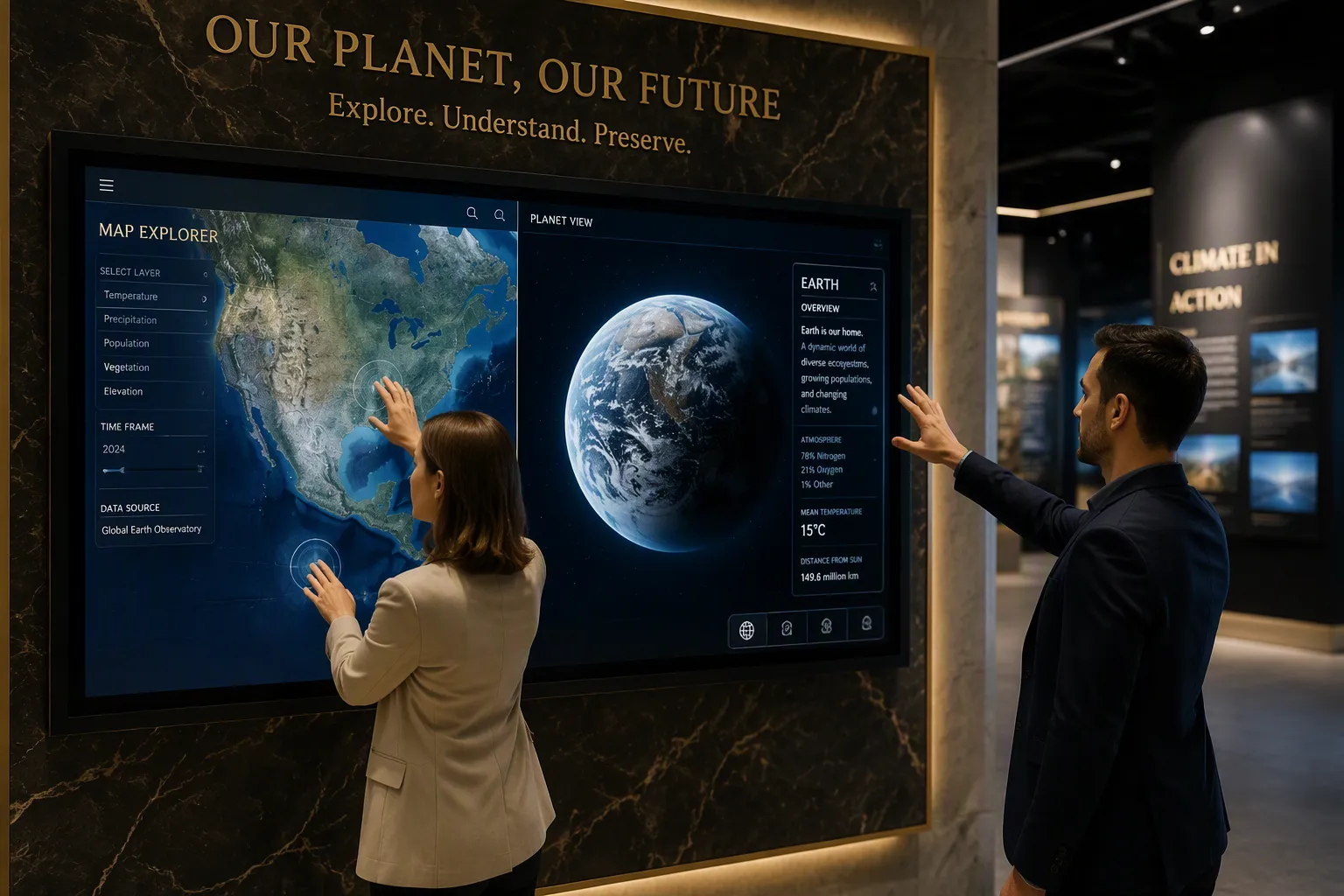
Gesture recognition extends interaction beyond physical contact. Motion sensors detect hand waves, allowing visitors to navigate content from a distance. This feature suits large-format presentations where users cannot reach the screen. A museum exhibit about space exploration might use gesture control to let visitors rotate a 3D model of a planet. The Interactive Exhibition Display should support both touch and gesture modes, switching seamlessly based on user proximity.


Interactive elements drive engagement in exhibition settings. Live demonstrations let visitors test products virtually. Quick quizzes challenge knowledge and provide instant feedback. Photo spots encourage social sharing and create memorable experiences. The display must handle these diverse interaction types without performance degradation. A robust processing unit and optimized software ensure smooth transitions between different interactive modes.


Integration with Other Inputs


A versatile Interactive Display Screen accepts input from multiple sources beyond touch. RFID readers identify visitors and personalize content based on their profile. Barcode scanners allow users to access additional information by scanning exhibit codes. Camera integration enables augmented reality experiences, overlaying digital content onto physical objects.


The Large Format Touchscreen Display should connect seamlessly with external peripherals. USB ports accommodate keyboards, mice, and storage devices. HDMI inputs allow content playback from laptops or media players. Network connectivity enables real-time data synchronization with backend systems. These integration options expand the display's functionality beyond basic touch interaction.


Interaction Type

Input Method

Engagement Benefit

Product Demo

Touch + RFID

Personalized experience

Educational Quiz

Touch + Camera

Immediate feedback

Photo Booth

Gesture + Camera

Social sharing


An Interactive Touchscreen Display with comprehensive input options adapts to changing exhibition requirements. Buyers should verify that the display supports the specific peripherals their content requires. Testing integration capabilities before purchase prevents compatibility issues during live events. A display that accepts diverse inputs becomes a flexible platform for creative exhibition design.


Plan Connectivity and Integration


Network and Peripheral Ports


A modern Interactive Touchscreen Display requires robust connectivity options to function within an exhibition ecosystem. Buyers must evaluate the available ports before finalizing their purchase. Standard configurations include USB ports for peripheral devices, HDMI inputs for external media sources, and Ethernet jacks for wired network access. These connections enable the display to receive content from laptops, media players, and central control systems.


Wireless connectivity adds another layer of flexibility. Wi-Fi and Bluetooth capabilities allow staff to push content updates without physical access to the device. A Large Format Touchscreen Display with dual-band Wi-Fi maintains stable connections even in crowded exhibition halls where wireless interference runs high. Bluetooth support enables integration with wireless keyboards, presentation clickers, and audio systems. Buyers should verify that the display supports the specific wireless protocols their organization uses.


Connectivity Type

Common Use Case

Recommended Standard

USB 3.0

Peripheral devices, data transfer

USB-A or USB-C

HDMI 2.0

External video sources

4K@60Hz support

Ethernet

Stable network connection

Gigabit (10/100/1000)


Compatibility with AV Systems


An Interactive Display Screen rarely operates in isolation. Exhibition booths typically include audio systems, video walls, and lighting controls that must work together seamlessly. The display should support standard AV protocols such as HDMI-CEC for device control and HDCP for protected content playback. These standards ensure the screen communicates properly with projectors, speakers, and video switchers.


Audio integration deserves specific attention. Built-in speakers may suffice for small booths, but larger spaces require external sound systems. The display should offer audio output ports, including 3.5mm jacks or digital optical outputs, to connect with professional audio equipment. Some configurations benefit from audio return channel support, allowing the display to send audio back to an AV receiver. Buyers should map their complete AV chain before selecting a display to avoid unexpected compatibility gaps. A thorough connectivity assessment prevents last-minute adapter purchases and technical failures during live events.


Organize Installation and Maintenance


Mounting and Physical Setup


The physical installation of an Interactive Touchscreen Display determines its effectiveness before visitors ever touch the screen. Exhibition booths benefit from vertical space utilization through tall backdrops or hanging signage. This approach draws attention from across the hall while keeping the booth floor open and inviting. A Large Format Touchscreen Display mounted on a sturdy wall bracket or freestanding kiosk must align with these design principles.


Mounting height directly affects accessibility and engagement. A display positioned too high excludes wheelchair users and shorter visitors. A screen mounted too low forces tall users to bend uncomfortably. The optimal placement positions the interactive zone between three and four feet from the floor. This range accommodates standing adults, seated visitors, and children alike. The mounting hardware must support the display's weight securely, preventing accidental tipping in crowded spaces. Professional installation teams should handle the physical setup to ensure proper anchoring and cable management.


Ongoing Support and Upgrades


An Interactive Display Screen requires continuous attention beyond the initial installation. Exhibition environments subject displays to daily wear, demanding regular maintenance schedules. Cleaning protocols protect the touch surface from residue buildup. Firmware updates address security vulnerabilities and improve performance. A vendor that offers remote diagnostics simplifies troubleshooting, allowing technicians to identify issues without visiting the booth.


Software upgrades extend the display's useful life. An Interactive Touchscreen Display with modular components permits individual part replacement rather than complete unit disposal. This approach reduces long-term costs and minimizes downtime during exhibitions. Buyers should establish a maintenance agreement with the vendor before purchase. This agreement should specify response times, replacement part availability, and scheduled checkups. A display that receives proper care delivers consistent performance across hundreds of exhibition days, protecting the initial investment.


Analyze Total Cost of Ownership


Upfront Purchase Price


The initial price of an Interactive Touchscreen Display represents only the first layer of investment. Buyers often focus exclusively on this figure, overlooking expenses that accumulate after installation. The purchase price includes the display unit itself, but additional costs emerge for mounting hardware, shipping, and professional installation services. A Large Format Touchscreen Display may require reinforced wall brackets or custom kiosk enclosures, adding substantial expense to the base quote.


Buyers should request itemized quotations that separate hardware, accessories, and services. This breakdown reveals hidden costs that inflate the final invoice. Some vendors bundle essential components like cables, power supplies, and mounting plates into the base price. Others charge separately for these items, creating an artificially low initial quote. A thorough comparison requires evaluating complete package pricing rather than comparing display units alone.


Long-Term Operating Expenses


Operating costs continue long after the initial purchase. An Interactive Display Screen consumes electricity continuously during exhibition hours. Energy efficiency ratings directly impact monthly utility bills, especially for displays running twelve hours daily across multiple events. Replacement parts, including touch sensors and backlight units, require periodic renewal based on usage intensity.


Maintenance agreements represent another recurring expense. Professional servicing protects the display's performance but adds annual costs. Software licensing fees may apply for content management platforms or firmware updates. Buyers should calculate the total cost across a three-year horizon, factoring in energy consumption, maintenance contracts, and anticipated component replacements.


Cost Component

Frequency

Consideration

Electricity

Monthly

Display runtime and brightness settings

Maintenance

Annual

Cleaning, diagnostics, firmware updates

Replacement Parts

As needed

Touch sensors, power supplies, fans


A comprehensive cost analysis reveals the true value of a durable, energy-efficient display. A slightly higher upfront investment often delivers lower lifetime expenses through reduced maintenance needs and longer service life. Buyers who evaluate total ownership costs make financially sound decisions that protect their exhibition budgets.


FAQ

How Long Does an Interactive Touchscreen Display Typically Last?

A quality Interactive Touchscreen Display lasts five to seven years with proper maintenance. Capacitive touch panels endure millions of touches. Environmental stress testing validates reliability. Regular firmware updates and cleaning protocols extend operational life significantly.

Can Staff Update Content Without Technical Training?

Yes. Modern Interactive Display Screen platforms feature drag-and-drop interfaces. Staff upload images, videos, and documents directly. Cloud-based management enables remote updates across multiple locations. No programming knowledge required. Most teams master the system within hours.

What Support Should Buyers Expect From Vendors?

Vendors should provide comprehensive warranty coverage, remote diagnostics, and responsive technical assistance. A Large Format Touchscreen Display requires documented service agreements specifying response times. Buyers should verify replacement part availability and scheduled maintenance options before purchasing.


購読

ぜひ読んで、最新情報を入手し、購読してください。ご意見をお聞かせください。

送信
Facebook Linkedin Twitter Youtube

著作権 © 2017 Guangdong Shengfeng Technology Co., Ltd. 全著作権所有 .サイトマップ | ブログ | Xml | プライバシーポリシー サポートされているネットワーク

伝言を残す

伝言を残す
当社の製品に興味があり、詳細を知りたい場合は、ここにメッセージを残してください。できるだけ早く返信させていただきます。
送信

ホームページ

製品

お問い合わせ